


Pre-Wet Salt Treatments
As referenced in the National Winter Service Research Guidance https://nwsrg.org/practical-guidance-documents , Pre-Wet Salt is a method which combines brine, with dry rock salt, at the point of spreader delivery. By applying a hybrid combination of liquid and granular de-icers, the de-icing reaction begins immediately. It provides an improved adhesion to the surface, less sodium chloride is used all whilst improving the quality of the winter service. This application is the most common use of de-icing brine and is adopted by the largest Road authorities in the UK.
Reduced cost
Pre-wet salt spreaders use up to 30% less rock salt when compared with dry and treated salt spreaders. Even once infrastructure costs are considered, savings in salt costs are substantial, feeding much needed savings back into budgets.
Safer Winter Treatments
Pre-wet salt is already in partial solution and therefore reacts immediately upon impact. As a result, it de-ices quicker than dry or other forms of salting. The effects are magnified under dry and windy conditions as pre-wet salt will contain less fines than its counterparts.
Increased resilience
With brine produced in the depot, there is a reduced reliance on rock salt. This means, putting depot teams in more control of their de-icing stocks. Up to 50Te of deicer can be stored in a space equal to 2 car park spaces.
Lower Environmental impact
A compound effect of less sodium chloride being released into the environment and 30% less deliveries of mined rock salt means that pre-wet salt constitutes one of the most environmentally methods to carry out the winter service.
When compared to dry salting, applying pre-wet salt can have large economic, quality and environmental benefits to the Winter Service. Salt only starts to de-ice when it reacts with moisture on the road surface (normally by dispersing Sodium Chloride particles with surface moisture or road traffic).
Pre-wet salt is already in partial solution and therefore reacts immediately upon impact. As a result, it de-ices quicker than dry salting. By replacing a portion of the salt with brine, there is a saving made on material purchases. By reducing how much salt is spread, the road surface and surrounding areas are less susceptible its corrosive nature.
It’s that effective that in most winter conditions, the National Winter Service Research Group Guidelines recommend using pre-wet salt at a reduced spread rate.
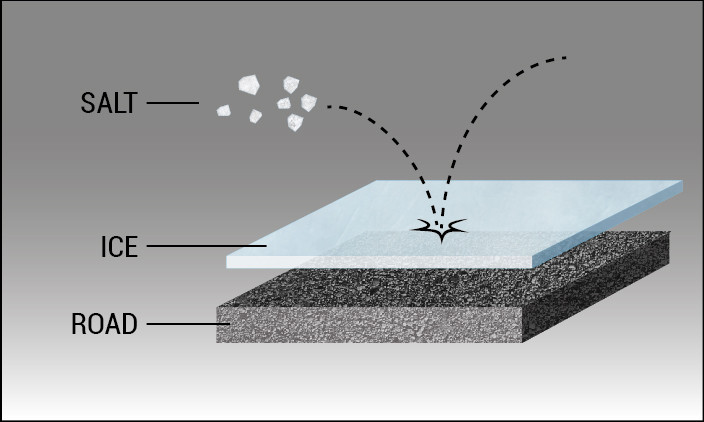
Dry Salt
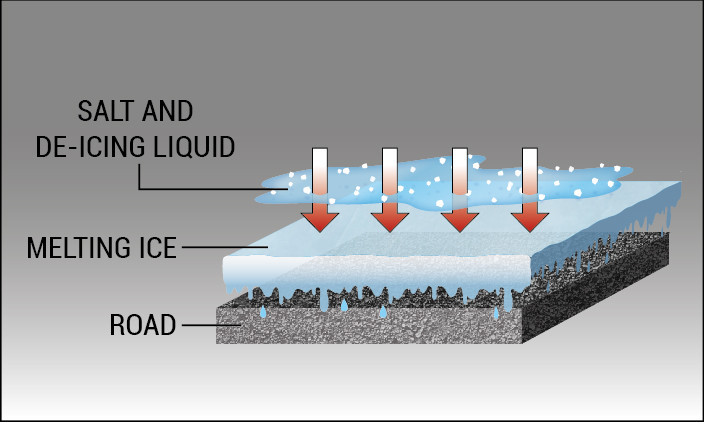
Pre-Wetted Salt
Liquid De-Icers
Liquid de-icers are now in common use in the UK. The balance of cost and quality make brine ideal for Direct Liquid Application (DLA) on cycle track and footpaths to ensure Active Travel can continue safely throughout the winter months.
Adding Brine to the de-icer mix is a practical and effective way to help reduce the cost of Winter Service, used directly as a de-icer or added to salt in a 70:30 or 50:50 mix, commonly known as ‘pre-wet salt’.
